
The annotations for the Snow White and the Seven Dwarfs fairy tale are below. Sources have been cited in parenthetical references, but I have not linked them directly to their full citations which appear on the Snow White and the Seven Dwarfs Bibliography page. I have provided links back to the Annotated Snow White and the Seven Dwarfs to facilitate referencing between the notes and the tale.
Special thanks to Ian Robinson, a professor at the Chisholm Institute of Technical and Further Education in Melbourne, Australia for providing most of the annotations to this tale. Annotations provided by Ian Robinson are followed with the initials IR and those written by Heidi Anne Heiner are followed by the initials HAH.
I have included the Grimms' notes to the tale as translated by Margaret Hunt followed by SurLaLune's textual annotations.
The Grimms' Notes For the Tale
From various stories from Hesse, where this story is one of the best known of all, yet even in that district, where High German especially prevails, the Low German name of Sneewitchen is retained, or even corrupted into Schliwitchen. In the opening it is like the story of theJuniper-tree; and it is still more like it in another story where the Queen, whilst driving with the King in the sledge, peels an apple, and cuts her finger while doing it. Another beginning of the story is this. A Count and Countess were driving past three heaps of white snow, and the Count said," How I wish I had a girl as white as this snow! "Soon they came to three pits filled with red blood, and again he spoke, and said, "I wish I had a girl with cheeks as red as this blood." Finally, three black ravens flew by, and he wished for "a girl with hair as black as those ravens." When they had driven a little farther they met a girl white as snow, red as blood, and with hair as black as the ravens, and this was Snow-white. The Count at once made her come into the carriage and loved her, but the Countess did not, and thought of nothing but how to get rid of her. At last she let her glove fall out and commanded Snow-white to find it again, but in the meantime made the coachman drive quickly away. And now Snow-white was alone and came to the dwarfs, &c. In a third story the only variation is that the Queen drives with Snow- white into the forest, and asks her to gather a nosegay of the beautiful roses there, and while she is doing it, drives away and leaves her alone. In a fourth, it is narrated that after Snow- white's death she is to he burnt by the dwarfs. They wrap her in a sheet, make a pile of wood under a tree, and suspend her over it by cords. Just as they are going to light the fire, the Prince comes, who has her taken down, and carries her away with him in his carriage. The motion of the carriage makes the bit of poisoned apple jump out of her throat and she comes to life. A fifth story has the following variations. A certain King loses his wife, by whom he has an only daughter, named Snow- white, and he takes another by whom he has three daughters. She, too, hates her step-child because of her wondrous beauty, and ill-treats her whenever she can. In a cave in the forest dwell seven dwarfs who kill every maiden who approaches them. The Queen knows this, and as she does not wish to kill Snow-white by direct means, she hopes to get rid of her by taking her to the entrance of their cave, and saying, "Go in there, and wait till I come back." Then she goes away and Snow-white fearlessly enters the cave. The dwarfs come and at first want to kill her, but as she is so beautiful, they let her live, and tell her that in return for this, she must keep house for them. Snow-white, however, has a dog called "Mirror," and now she is gone, it stays in the castle, and is full of grief. The Queen asks it,
"Mirror, mirror beneath the bench,
Look in this land, look in that land,
Who is the fairest in Engelland?"
The dog answers, "Snow-white with her seven dwarfs is much more beautiful than my lady Queen with her three daughters." Thus she becomes aware that Snow-white is still living, and makes a poisoned stay-lace. With this she goes to the cave and calls to Snow-white that she is to open the door to her. Snow-white will not do it, because the seven dwarfs have strictly forbidden her to let in any human being, and certainly not the stepmother, who has tried to destroy her. The Queen however tells Snow-white that she has no daughters now, for a knight has robbed her of them, and that she would like to live with her and dress her prettily. Snow-white pities her and lets her in, and then the Queen laces her with the poisoned stay-lace, and she falls down dead, whereupon the Queen goes away. But the seven dwarfs come and take a knife and cut the stay-lace in two, and Snow-white returns to life again. And now the Queen questions Mirror (the dog) under the bench, and it gives her the same answer. Then she makes a poisoned hair-ribbon, and goes with it, and speaks so movingly to Snow-white, that she again lets her in. The Queen binds the ribbon round Snow-white's hair, and she falls down dead. But the seven dwarfs see what has happened, cut off the hair-ribbon, and she is restored to life. The Queen questions the dog the third time, and receives the same answer. And now she goes with a poisoned apple, and in spite of all the warnings which Snow-white has had from the dwarfs, she is touched by her lamentations, opens the door, and eats some of the apple. Then she dies, and when the dwarfs come they can do nothing for her, and" Mirror," under the bench, tells the Queen that she is now the most beautiful. But the seven dwarfs make a silver coffin, put Snow-white into it, and place it on a tree in front of their cave. A Prince comes by, and asks the dwarfs to give him the coffin, and takes it with him, and when he gets home has her laid upon a bed and dressed as if she were alive, and loves her above measure. A servant has to wait on her continually; but one day he gets angry at having do to this, and says, "The dead maiden is just to be treated as if she were a living one," and gives her a blow on her back, on which the piece of apple comes out of her mouth, and Snow-white is once more alive. A Viennese version of this story gives the following incidents. There are three sisters; Snow-white is the prettiest and youngest. The other two hate her, and send her out into the world with a loaf of bread and a pitcher of water. Snow-white comes to the glass mountain, and keeps house for the dwarfs. And now, when the two sisters ask the mirror who is the fairest, it answers,
"The fairest is on the Glass mountain,
And she dwells with the little dwarfs."
They send some one thither to poison Snow-white. See Richilda in Musaus, where the rhyme runs thus:
"Mirror white, mirror bright,
Mirror, let me have a sight,
Of the fairest girl in Brabant!"
It is also a genuine incident that, in the end, the dwarfs make steel slippers, heat them till they are red-hot, and put them on the feet of the stepmother, who is forced to dance in them until the floor smokes. In Wallachian, see The Magic Mirror, Schott, No.6. In the Pentamerone, the Kitchen-maid (2. 8).
There is a remarkable unison between this story and a Norse one, which has already become almost an historical saga. Snafridr, a most beautiful woman (qvenna friduzt), wife of Herald Harfager, dies, "and her countenance was not in the slightest degree altered, but she was just as rosy as if still in life. The King sat by the corpse and thought she would return to life, and thus he sat for three years." (Haraldssaga, chap. 25; Heimskringla, 1. 102). For the drops of blood upon the snow, compare the preface to Liebrecht's Translation of the Pentamerone, xxi. xxiii. The punishment of having to dance till dead occurs also in a Danish popular saga (Thiele, 1. 130), and the seven gold mountains in a Swedish popular song, in Geyer, 3, 72, 74; and in Firdusi (Görres, 1.180), there is "on seven mountains must thou alight, where crowds upon crowds of frightful Deevs meet thee."
Grimm, Jacob and Wilhelm. Household Tales. Margaret Hunt, translator. London: George Bell, 1884, 1892. 2 volumes.
SurLaLune's Annotations
1. "Sneewittchen": "Both elements of this
compound word are in Low German, although the tale itself is
recorded in High German. The High German form of the heroine's
name would be Schneeweißchen." The literal translation is
"Little Snow White" (Ashliman 2002). IR & HAH
Return to place in story.
2. Middle of winter: Midwinter is the turning point of the seasons, the beginning
of the Sun's ascendant phase. IR
Return to place in story.
3. Pricked her finger with the needle: The accidental pricking of a finger also occurs in Briar
Rose/Sleeping Beauty. IR
Return to place in story.
4. White as snow, as red as blood, and as black as the
wood:The three colours, white, red and black represent the three
aspects of the Triple Goddess: maiden/mother/crone. IR
Return to place in story.
5. Called Little Snow-white: Although she is as white as snow, as red as blood, and as
black as ebony wood, she is named after only one of these
aspects of the feminine. IR
Return to place in story.
6. The King took to himself another wife: In the first edition, the version closest to its oral sources,
Snow-White's jealous antagonist is her own mother. In the
edition of 1819, the Grimms here added the statement that
Snow-White's mother died during childbirth, and that her father
remarried, so the jealous Queen was made her stepmother
(Ashliman 2002). IR
Return to place in story.
7. She had a wonderful looking-glass: The first 'mirrors' were pools of water. In Greek myth, the
youth Narcissus caught sight of his own reflection in a pool and
fell in love with it. He gave his name to the modern
psychological term narcissism which indicates an excessive
preoccupation with oneself and one's own appearance and
concerns. IR
In this story the mirror represents:
(a) the 'male gaze' which objectifies the female,
(b) the husband/father who is otherwise absent from the story
and for whose approval both Snow White and her mother
compete. IR
Return to place in story.
8. The looking-glass answered: The clairvoyant speaking mirror is a common motif in Asian
& European folk tales. In some cultures it was believed that
the reflection in a mirror represented the Soul, which is why it
is bad luck to break a mirror. IR
Return to place in story.
9. Seven years old: Seven is the age of transition from child to maiden. IR
While seven was often considered the age of transition from
child to adult in past centuries, the stated age is often
ignored in illustrated or film versions of the story and made to
appear much older. Since the story does not mark a significant
amount of time, the image of a seven-year-old child marrying the
prince at the end of the story fails to appear romantic, but
rather abusive. In some versions of the story, the child
continues to grow into a young woman as she sleeps, proof that
she is not quite dead although not quite alive either, but
nonetheless justifying the dwarfs coffin-side vigilance. HAH
Return to place in story.
10. Heart: The earliet versions of the tale used the lungs and liver instead of the heart. HAH
Lungs represent the breathe or the spirit (Gr. psyche, L.
spiritus) & in medieval times the liver was thought to be
the seat of love and erotic desire. IR
Return to place in story.
11. Boar: The
boar represents courage and lust. In Norse mythology the boar
was sacred to the divine twins Frey and Freyja who were the
deities of sexual desire & fertility. IR
Return to place in story.
12.The wicked Queen ate it: Some believed that by eating certain organs one acquires the characteristics and the power of the person one eats. IR
In this instance, the queen is trying to make Snow White's
beauty her own by ingesting a part of the young girl. HAH
Return to place in story.
13. Great forest: The dark and mysterious forest is often a place of exile where
psychological growth occurs. It symbolizes the unconscious, the
realm of the psyche. It is often a threshold through which the
soul encounters the perils of the unknown and survives as a
wiser person. IR
Return to place in story.
14. Seven: The number seven is the number of completeness and totality - it is the sum of three (the number of the heavens - the triple goddess, the trinity) and four (the number of the earth which has four corners, four elements, four winds, four seasons, etc). Seven is a manifestatin of the cosmic order, a symbol of perfection and fullness, and also of introspection, meditation and understanding.
Thus we have for example:
7 days of creation
7 planets
7 colours of the rainbow
7 notes in a scale
7 days in a week
7chakras
7 deadly sins
7 ages of man
IR
15. None of them suited her: Snow White's eating of the food, testing of the beds, and
discovery by the dwarfs is similar to Goldilocks' trespassing
upon the Three Bears, albeit with different results. HAH
Return to place in story.
16. Dwarfs: Dwarfs in symbology represent the
underdeveloped and the unformed. They are pre-adolescent and not
developed sexually. They live an immature and
pre-individualistic form of existence that Snow White must
transcend. (In the original story they are not individualised
and Walt Disney by giving them names and personalities has
destroyed their meaning in the story.) The dwarfs are also close
to the earth (they mine for gold which is the incorruptible
metal) and they represent the unconscious and amoral forces of
nature. IR
In some traditional versions of the story, the men who rescue
Snow White are robbers, not dwarves (Philip 1997). Also note
that the dwarfs are sexually unthreatening to Snow White thanks
to their "underdeveloped" appearance. In contrast, their
devotion heightens her apparent beauty for the
listener/reader. HAH
Return to place in story.
17. She stayed with them: The period of time Snow White spends with the dwarfs is a
period of latency and repressed desire. Snow white learns about
the work ethic and is socialised into woman's domestic role, but
the question of her womanhood, her sexual desirability as a
woman, which was raised by her mother's mirror, has been put
aside for a time. IR
Return to place in story.
18. She had at last thought of something to do: The three temptations of Snow White are symbols of life beyond
the cottage and they appeal to Snow White's vanity and
narcissism, her need to look sexually desirable, her awareness
of how she looks in a mirror. Three is sacred to the Goddess of
Love and Desire, Aphrodite who is Queen of the Three
Worlds. IR
Return to place in story.
19. Yellow, red, and blue silk: Yellow (gold) represents the soul, red (the colour of blood)
represents the body and blue represents the intellect. IR
Return to place in story.
20. I may let the worthy old woman in: Many fairy tales involve the breaking of a command or a taboo.
There can be no psychological growth until the old rules are
broken and the new order can flourish. IR
Return to place in story.
21. Lost her breath and fell down as if dead: The first temptation relates to Snow White's body, but the
bodice laces bind her too tight and she cannot breath - breath
is a symbol of the spirit. IR
Return to place in story.
22. Poisonous comb: The second temptation relates to Snow White's head and her
hair. Combs were an attribute of Aphrodite, the Sirens and
mermaids all symbols of female desirability. Hair is a symbol of
fertility and virility, but the comb tames its wildness and its
poison nearly kills her. IR
Return to place in story.
23. Apple: The apple was sacred to Aphrodite
and represented knowledge, especially sexual knowledge,
fertility and love. IR
In times past, offering an apple was a symbol of love and
affection (Philip 1997). HAH
Return to place in story.
24. Hardly had she a bit of it in her mouth than she fell down
dead: The apple is lodged in Snow White's throat - her organ of
speech is blocked and she cannot articulate her needs or her
individuality. IR
Return to place in story.
25. She breathed no longer and was dead: Snow White must die to the pre-pubescent world of the dwarfs
in order to be eventually reborn into the adult world as a
sexually active women. IR
Return to place in story.
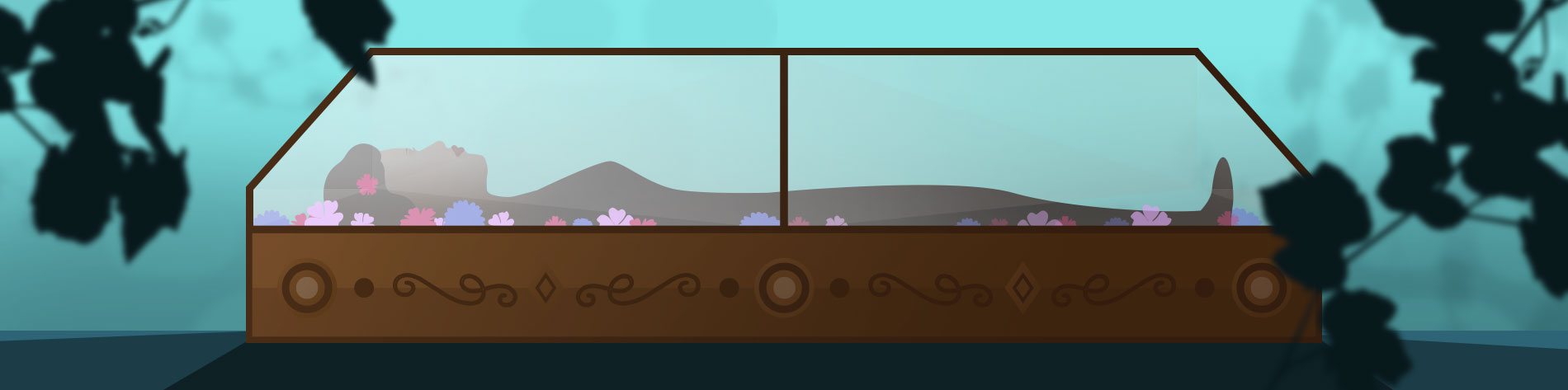
26. Coffin of glass: Snow White in the glass coffin is like a butterfly in the
chrysalis stage, awaiting to emerge as an adult. The coffin is
glass so her body is on display and continues to be an object of
male desire. IR
Return to place in story.
27. King's son: In many fairy stories the sleeping heroine is woken by the
kiss of a man (eg 'Briar Rose'/'Sleeping Beauty'). In this case
it is his love and devotion that (indirectly) cause her
awakening. In either case this symbolises the fact that a girl
must be awakened to womanhood by a man. IR
Return to place in story.
28. Stumbled over a tree-stump: "Beginning with the edition of 1819, the poisoned apple is
dislodged when a servant accidentally stumbles while carrying
the coffin to the prince's castle" (Ashliman 2002). IR
Return to place in story.
29. Iron: Iron was the only metal not sacred
to the goddess so it is used to punish the evil mother who
represents vengeful female energy. IR
Return to place in story.
30. Slippers: Shoes are a symbol of female sexuality (cf 'Cinderella'), hence the custom of tying shoes to the back of a wedding car. IR
Footwear is important in many popular fairy tales, such as Cinderella's slipper, the boots in Puss in Boots, and the worn-out shoes in The Twelve Dancing Princesses. HAH
Return to place in story.
31. Dance until she dropped down: The theme of footwear that makes you dance until you die was
later used by Hans Christian Anderson in 'The Red
Shoes'. IR
Return to place in story.
32. Dead: Bruno Bettelheim interprets the
story as a classic mother/daughter conflict in which children
receive cathartic pleasure in seeing the mother/stepmother
endure a horrible punishment for her crimes against innocent
youth (Bettelheim 1975). HAH
Return to place in story.
Special thanks to Ian Robinson, a professor at the Chisholm Institute of Technical and Further Education in Melbourne, Australia for providing most of the annotations to this tale. Annotations provided by Ian Robinson are followed with the initials IR and those written by Heidi Anne Heiner are followed by the initials HAH.